
Leave Your Leaves!

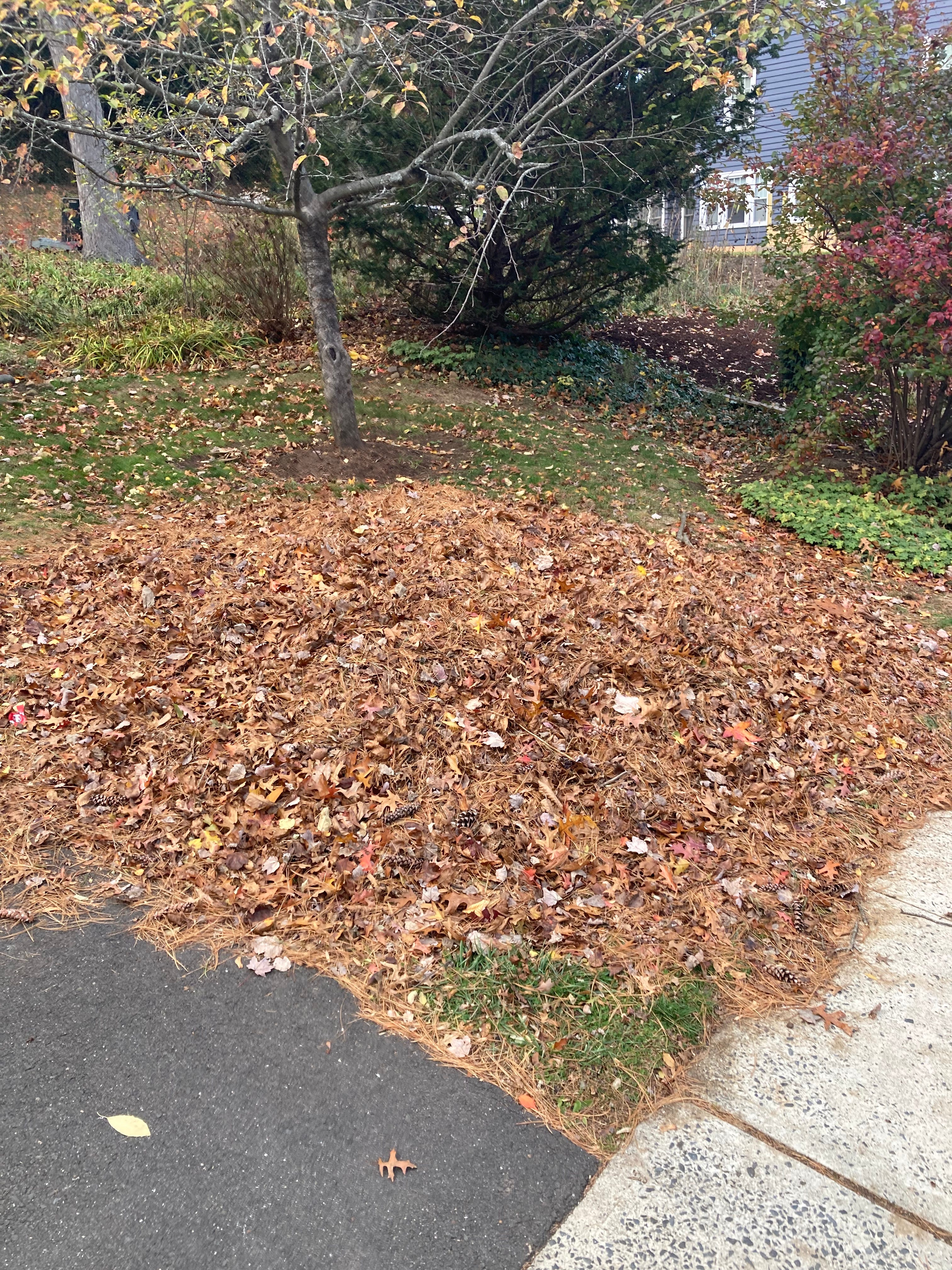
I hear them almost every day — those infernal, incessant gas-powered leaf blowers, roaring, scattering leaves in a time where quiet rakes are regarded as primitive prehistoric (and obsolete) implements.
You probably hear them too. Especially in the leaf-falling months of October and November. Those blowers are with us for hours. Every day.
I have a smaller yard than most of my neighbors (the photo above is of a nearby yard, not mine) and I’m still physically able to handle my leaves without hiring a noisy “lawn service.” But in my back yard and to a lesser extent in my front yard I do have fallen leaves that must be attended to.
What do I do with them? I rake them. I put them in piles, then jam the leaves into tall paper lawn bags for the City of New Haven to pluck off my curb.
That’s what I’ve been doing for decades. But this year I’ve decided to try something different: leaving the leaves, at least in my back yard. I will rake them into piles but I will then carry them to a nearby fenced-in corner rather than bagging them.
I hit on this plan after reading a feature story in the New York Times (“Relax on Weekends and Help Your Yard” by Margaret Roach) and an op-ed in the New Haven Register (“Those Leaves Aren’t Litter, They’re an Ecosystem” by Jack Keller. They made me realize that thousands upon thousands of tiny creatures dearly need our fallen leaves.
Max Ferlauto, co-author of a Maryland study on the effects of leaf removal, says this: “When you remove the leaves instead of retaining them, you reduce the number of moths by 45 percent, the number of spiders by 56 percent, on average, and the average number of beetles by 24 percent.” Butterflies also fall off by an average of 44 percent.
As for insects, he said, “You could literally be destroying them or you could be changing their micro-habitat such that they don’t survive.”
He advises: “If you have to rake your leaves, moving them to another location is OK.”
But he also advises spreading them out. “If your pile is too deep, the insects are not going to get the cues that they need to know when it’s time to emerge.”
And this from Keller’s op-ed, quoting the U.S. Department of Agriculture: “Leaves serve as a habitat for wildlife, including lizards, birds, turtles, frogs and insects that overwinter in the fallen leaves.”
Keller noted that gas-powered blowers operate at between 85-125 decibels, which can cause permanent hearing loss. He also cited a report by the U.S. Public Interest Research Groups Education Fund: lawn and garden equipment powered by gasoline and other fossil fuels released more than 30 million tons of carbon dioxide into the atmosphere in 2020 — more than all the greenhouse gas emissions from the City of Lost Angeles.
Keller also reported: “Running a gas-powered leaf blower for just 30 minutes emits the same amount of hydro-carbon emissions released by a Ford F150 driving from Maine to L.A.”
But there is hope, Keller added: More than 200 cities and towns in the U.S. have banned the use of gas-powered leaf blowers. Five of them are in my state of Connecticut. But one has to wonder: how the hell can you enforce such a law? Who is watching the omnipresent lawn service crews?
In a few weeks, when most of the leaves have fallen, I will commence raking. Then I’ll let you know how my little back yard experiment is faring.
Jacki -- It's clear you have solved the problem; nice going.
Thanks, Randy. I really appreciated this piece. I’m with you on the gas powered blowers. I mean I’m furious with their omnipresent roaring noise, the foul smelling fumes and toxic air they produce, etc… but I would have thrown in a few expletives to make the case for banning them. You’re to be commended for your restraint.